May 2, 2014

Welcome to Norwegian


Finally another update! I'm sorry for the long delay of this post – I've been really busy all the time, and since I moved from Ljungbyhed on March 20 until a week ago I've not had an actual home but stayed at hotels or slept on the couch in my parents' house. We've done so much, and it's so fun!

In the middle of March we finished the technical course on the Boeing 737 with a test which we all passed without problem. The technical course was mainly done with a computer based training software online (CBT). It's pretty pedagogical using tons of illustrations and animations while explaining all details both aurally and in text. I'd say the material would take at least 20 hours of effective time to just scroll through, but in practice I had to repeat a number of parts simply because of failing concentration. This was supplemented with question sessions with one of the school instructors and completion of numerous mock examinations.

Immediately upon completing the technical test we all moved from Ljungbyhed within a few days – many of us including me on the very same day. In addition to studying for the technical test and preparing the move during the last week in Ljungbyhed we also were to write a report about a human factors related aviation incident to be presented in class upon arrival in Oslo a few days later. Finally there were lots of paperwork to be done before the reason we were going to Oslo – a 2½ week company course at the Norwegian airline headquarters.

We would not directly be less busy after arrival in Oslo – the company course was heavier than I had anticipated and during the 16 days there we completed two more CBTs (computer based training software), a couple of exams on company specific procedures and almost every weekday was a full day of classes starting 08:00 in the morning which meant getting up before 07:00. Mostly theoretical classes about Norwegian and the Boeing 737 but also some practical stuff such as trying out some emergency equipment. Most significantly, we tested opening emergency exits, jumped the emergency slides and did a throughout inspection of the Boeing 737 fuselage including opening all kinds of hatches and covers.

All in all, the 16 days company course was instructive, very interesting and really fun. During the two weekends, except for studying procedures, we enjoyed visiting some famous places in Oslo. For accommodation we rented two large apartments with four rooms for six students each. After close to two years in Ljungbyhed with like-minded companions and close friends all around us it was like a short extension of having that atmosphere.

After the company course we were finally to begin the simulator training which has occupied our time for the last two weeks. The school has paired us for these 24 lessons, which are 4 hours each. Adding the 4 hour skill test for obtaining the certificate, we'll spend 100 hours in the simulators. In the future for as long as we work as commercial pilots we'll also get at least the legal minimum of a four hour proficiency check every six months. The main objective in all simulator training is to practice abnormal situations, which means that we during almost every session in the simulator get numerous problems such as engine failures, broken navigation systems, rapidly leaking cabin pressure and of course all kinds of fires. We are also made sometimes to suddenly pretend we lose consciousness, so that the other pilot will have to control the airplane all by himself.

This far me and my partner Rickard have completed 8 simulator lessons, that is 1/3 of the total. It's really fun and the simulators are extremely realistic as they move around according to acceleration, turns, turbulence, disintegrating engines etc. During the 8th lesson  we finally simulated a complete flight with everything from preparations to shutting down the aircraft, on a short route from Oslo to Trondheim and then back again (switching positions). Having managed practically all parts of the flight without instructor intervention, we could gather some self-confidence that we really will do fine just two months from now when flying the real thing, having the responsibility for the safe transport of up to around 200 people (including crew).

Photos:
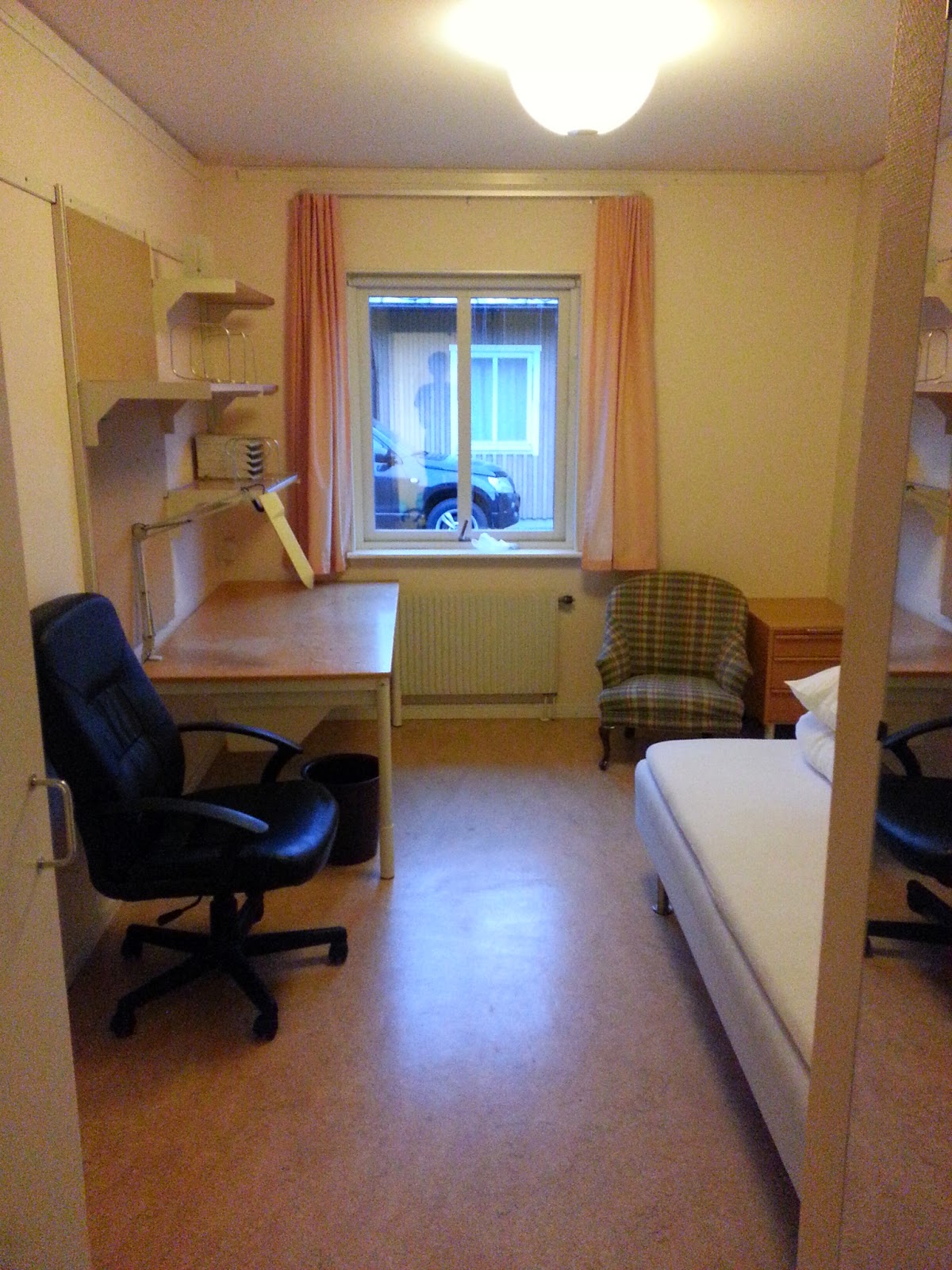
 Bye bye Ljungbyhed and the wonderful atmosphere at dormitory Ljunghusen, I already miss you!


 There are quite a lot of emergency equipment onboard a Boeing 737 to learn about. There's even an AED (automated external defibrillator) in case someone gets a heart attack. It's not a legal requirement to have one, but just on Norwegian flights close to 20 lives have been saved where the AED was used.

 The simulator training facility not only has cockpit simulators for pilots, there's also cabin simulators for cabin crew who train evacuation procedures and such. We also had to practice opening doors and jumping the slide.

There's also the possibility to practice fire and smoke handling in a cabin simulator, which we also had to do.

The view from Aker brygge in downtown Oslo is not bad at all.

 One of the highlights of the company course was of course to visit the airport hangar and see and feel all parts of the aircraft for real. The dark picture is from inside the wheel well (where the landing gear is stowed – quite spacey!).

 
This is where me and my simulator partner will spend 100 hours together during the two month period ending in the middle of June. A lot to learn, and a lot of fun to have!

March 13, 2014

Final period in Ljungbyhed


Almost 960 hours and no see!

As I was before the last post, I've continuously been very busy at school. The main part of the human factors course was completed in January, and after a few weeks of self-studies parallel with flying the twin-engine PA-31 Navajo we've now also had the final theory exam. Fortunately, all twelve students of my class passed the exam with a good margin. The only thing remaining of that course is to submit a five page report on an air accident or incident of one's choice, whose cause is related to human factors. We will then present our conclusions and discuss them on a final classroom meeting, actually in Oslo immediately before our airline course.

The PA-31 flying was really fun! Even though some of us had flown other aircraft outside school at flying clubs etc. and some before they entered the school, nobody had flown a twin-engined or such a large aircraft. Having eight seats in a fairly spacious configuration, retractable landing gear and more than double the engine power compared to the Cirrus SR20 it flies quite differently and it was certainly some valuable 7.5 hours of flying experience. Except being larger and more powerful the individuals in our school's possession are fairly old and so the instrumentation is old-fashioned. While it's not likely we'll ever fly with analog basic instruments commercially, I think that was also some valuable experience.

During these few flight lessons we mostly practiced basic instrument flying focusing on the differences with a larger aircraft and the two engines. Thus, much of the flying time was actually done without getting thrust from one of the engines  (setting the thrust lever to zero) practicing handling an engine failure. This means using the feet pedals to control the tail rudder to stabilize the aircraft which otherwise would turn due to the power coming from only one side of the fuselage. Constantly pressing one feet down in this situation is very tiring for one's leg and it's quite challenging in the beginning to still do all the procedures correctly.

After having finished our flight lessons we had a short school trip to Linköping where we got the opportunity to try our capabilities in two possible emergency situations. Firstly we did a hypoxia (lack of oxygen) test where we wore oxygen masks that were fed with air containing an abnormally low amount of oxygen corresponding to an altitude of about 6.7 km. We then were told to solve some puzzles on a paper while talking to an instructor and while an operator monitored our pulse, oxygen blood saturation level etc. After about 5 minutes I started to feel warm and a little dizzy, and the test was aborted. All my classmates did the same test, and the amount of time until saturation levels decreased and what symptoms one got varied a lot from person to person. The objective of the test was simply to experience hypoxia  and learn about our individual symptoms to be able to recognize them in the case the cabin pressure would decrease in an airplane and warning systems would not be operational (very unlikely, yes).

The second test on the second day was performed in a small 4 x 3 meter pool. Imagining we had survived a water landing on a rough sea we practiced swimming around with clothes and a life vest on and getting people onboard a life raft. There were waves, strong wind and rain and darkness to make the task more difficult. In the end we were pulled up by a helicopter winch (attached to the ceiling of the room) and rescued. The exercise lasted about 40 minutes, was quite fun and felt very valuable.

Coming back to Ljungbyhed, we then resumed the multi crew cooperation – MCC simulator training. We had most of the simulator lessons where we learn to cooperate in the cockpit in November and December but a few lessons were postponed to not make the gap between school simulator training and the full-scale Boeing 737 type rating simulator training too long for us. Indeed most of us felt a little uncomfortable after the two month interruption, but fortunately it didn't even take one lesson until at least I felt almost as accustomed as I had felt in December. My last four lessons were quite eventful (being the final most difficult part) and we had to cope with doors coming off in mid-air, sick passengers, burning engines, fire and smoke in the cabin  and of course really bad weather all the time. At one time the student who was captain had to pretend to get unconscious leaving the co-pilot alone to do everything including landing safely.

Finally, we're now in the middle of our technical course on the Boeing 737. We must learn lots of general knowledge about the aircraft and not the least learn to quickly find facts about any specific feature in the aircraft manual of 1800 pages. Next Monday we have the school technical exam, then on Wednesday we do the full-scale exam for the airline. We then all leave Ljungbyhed for good on Wednesday or Thursday. Next we meet up in Oslo a few days later on Sunday to have our human factors course report presentation and during the following three weeks we have the airline course learning airline specific procedures and policies. After that we'll begin the Boeing 737 type rating simulator training!

As you see, we'll continue to be busy for a while, so don't expect the next blog update to be faster than this was. But it could be.

As a final word, I would like to congratulate all the successful candidates who now have gotten their proofs of admission to TFHS. While it feels a little sad to not be able to be here when you arrive, you are very welcome, and I wish you a huge good luck! We'll surely meet quite a few times anyway, see you in Ljungbyhed!

Photos:
PA-31 in all its beauty!

 
Water emergency training in Linköping.

Final MCC simulator lesson finished. We flew a flight from Frankfurt that was scheduled to Zürich but due to bad weather we had to divert to Geneva.

  
Many people squeezed into this room during the Olympics, where we also had a deep-fried buffet night.

February 1, 2014

Prospective students in Ljungbyhed


A late happy new year!

This last 1½ month I've been quite busy. As I wrote in the last post, the final part of the fall semester was very hectic and while it felt relieving to go "home" to Falun I've been continuously busy all the time up till now. After a few days at home celebrating Christmas I headed eastwards for Japan, spent 16 days in my second home country, and then returned to Ljungbyhed via a short visit in Uppsala. Immediately upon returning, a course in human factors begun, which then finally ended, although temporarily, today. While we "only" have had six full days of classroom lectures, we've had to read literature on the subject in between and we also had a two full days slightly unexpected course on leadership during this period. I've also taught as a private teacher three evenings, had a visitor for six days and been to Falun four days during the same period. But from now it'll be just a little less intense for a while.

The human factors course is a sequel to the HPL - human performance and limitations - course that is part of the ATPL theory block and which we completed in October. The course contents is also similar, focusing on crew resource management, that is how to communicate effectively with other crew members in order to enhance safety. Even more than during the previous course we now discuss openly many different aspects of cooperation, organizations, authority, personality and culture etc. And we study many historical airliner accidents and incidents which could occur because the communication was deficient.

During the leadership course we discussed even more openly about personality, authority etc. using personal experiences and numerous self evaluation methods in order to learn more about ourselves and our qualities in a leadership situation. It was an interesting course while the objective of the course felt quite vague and I'm not sure if I've learnt much new things that will help me in the future. According to several friends  who participated in the same course at earlier occasions or in another similar course, I will apparently have use of that knowledge together with own reflections on my own behavior over time, so I'll simply have to be patient.

Having finished  the theory part of the human factors course, what's remaining is a written exam and a report about a specific airliner accident or incident whose cause is related to the subject. Starting next week we'll fly the PA-31 Navajo twin-engine slightly larger airplane for just around 8 hours, which we all look forward to a lot. And in two weeks and a few days from now, we will head for Linköping, hopefully in the same aircraft, in order to perform pressure chamber tests which will be really exciting. We'll get to experience hypoxia (lack of oxygen), using a rescue raft in a stormy ocean and more things.

Finally, I want to wish all the applicants for the 2014 TFHS class a huge good luck with the entrance examinations! Since I say this quite late I think all parts of the examination is already finished with the remaining 60 applicants waiting for the final results. For those who are accepted: huge congratulations! This is a great school and my picture this far of the occupation itself is that it's a challenging and exciting one. For those who are not or didn't apply: there is another chance next year and you're very welcome to try again! Think about what went wrong and your chance will surely we greater next time. Information about application and the school is to be found here:
http://www.tfhs.lu.se/

All applicants meeting the criteria of a high school exam with a grade in certain subjects, and having obtained a passing pilot's suitability test from a specialized psychologist are called to a full day of written exams. The applicants with the best results are then called for an interview at the school and the final decision depends on the total impression of each applicant including previous experiences, written exam results and psychologist statement. During this winter application period, about 160 qualified applicants carried out the written exams, and of them about 60 applicants were then interviewed. 20 students will be admitted each year. The full program is 2½ years long, is mostly located in Ljungbyhed and results in a YH (Yrkeshögskolan) degree of 500 YH points, an MPL, Multi-crew Pilot Licence including type rating on a Boeing 737 and a few hundred hours of commercial airline experience as a first officer. A high level of understanding of Swedish is probably necessary as well as an EU (or Nordic) country citizenship or long-term visa due to Swedish school fee policies.

I don't guarantee the accuracy of the above explanation of the application process, refer to the website!

A really nice video of Arlanda showing the beauty of aviation (author Jesper Rådegård):